Visionary or Liability: How to Protect your Portfolio Against Bad Founders
Richard White sold on 43 of the 92 days in the December 2024 quarter. Mineral Resources is down 70% since May 2024. The sell signals were visible first.

First published in Equity magazine (Australian Shareholders’ Association), May 2025.
Every investor loves a founder story — but beware of blind faith. We assume 100% of founders succeed because of the many studies showing that they outperform. Too often though, investors bet too much on charisma and vision alone, without paying any heed to warning signs that a founder’s motivation has fundamentally changed. What is thought to be a founder’s premium actually becomes a portfolio risk. The founder’s hype train loses momentum and the market flips its opinion, sharply reversing years of gains. There are ways to avoid this scenario – investors have many early warning signs available at their disposal should they be humble enough to accept that blind faith alone is not a viable investment strategy.
Founders behaving badly
WiseTech is a prime example of founder risk. In October, founder Richard White became embroiled in a governance crisis following allegations of inappropriate behaviour toward women. He stepped down from his role and sold a significant portion of his equity. The share price initially fell 30%, but quickly rebounded to record highs as investors bought the dip. But things weren’t put to bed as many had thought. Further allegations surfaced in January, triggering a board spill and prompting major institutional investors to exit, criticising the company’s governance as they left.
The same movie played out with Chris Ellison at Mineral Resources, who, for many years, was the enigmatic and unconventional founder-CEO that had the midas touch. Then it all fell apart in October 2024 when a host of tax evasion allegations came to light. Mineral Resources’ share price is down 70% since May 2024.
Things could have played out differently had investors spotted the early sell signals. In WiseTech’s case, investors had a clear three-month window to lock in gains before the board resignations triggered a 40% drop from the highs. The warning signs were there – it just required the clarity to act.
Telltale signs of founder danger
To distinguish founder hype from the real deal, investors can monitor five critical signs:
1. Taking money off the table
Forget the “diversification” excuse. When a founder starts selling large blocks of stock, especially after a run-up, it’s rarely random. WiseTech’s Richard White offloaded over $450 million of stock close to all-time highs. This was after the accusations of inappropriate conduct emerged (disclosures show he sold on 43 out of the 92 days in the December 2024 quarter) – a clear warning sign.
Similarly, with Afterpay, large founder sell-downs occurred shortly before its acquisition by Block – a sign of shifting motivations and perhaps the end of founder conviction.
Investors should pay caution to both Palantir’s exceptional hype and Alex Karp’s recent dumping of $1.9 billion shares as the stock continues to soar.
Extra vigilance should be given when share price growth comes from founder hype rather than founder fundamentals.
2. The do-it-all founder
Founders who monopolise decision-making may present risks for investors. These “bottleneck founders” block scale by refusing to empower others, often showing up in chronic founder over-involvement. Magellan under Hamish Douglass is an example of when this risk eventuates.
On the contrary, founders that can disseminate the operating system for their company, rather than be the operating system, are able to build lasting success. Look at Flight Centre’s “Tribes” model – decentralisation allowed the business to remain agile and innovative. If the organisation isn’t designed to function without the founder, it’s not built to last.
3. Boards and company decision-making
Investors should avoid boards stacked with career board directors (likely ‘yes’ people), and instead look for board members with relevant operating experience. Large board sizes are unfavourable – they dilute accountability and dilute the founder effect. Instead, look for small boards that can preserve decision-making agility – a key advantage of founder-led companies.
4. Big bets
Markets reward ambition only up to a point. When a single initiative puts the entire firm at risk, it’s time to re-evaluate. The best founders place continuous, calculated bets, driving upside without jeopardising the business if they fail. If the big swings keep getting bigger, consider trimming the position.
How to benefit without minimising risk
Build a deep bench of founder-led stocks across geographies and sectors. When red flags emerge, take profits and rotate in from your bench. Investors can ride the founder premium and de-risk with this active rotation strategy.
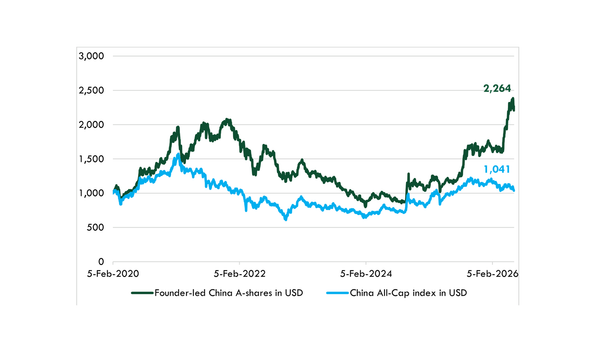
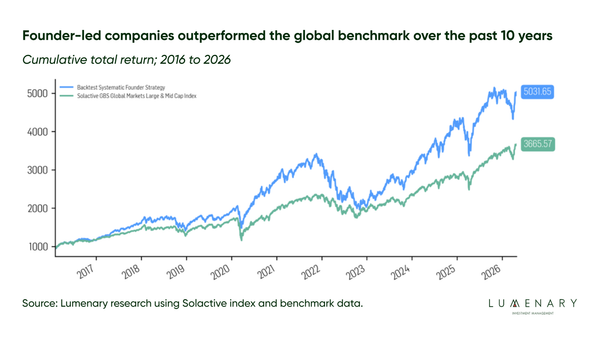
Even great founders can be overvalued. When the market overhypes, take some off the table. When it underappreciates, add. Founder-led investing isn’t a set-and-forget strategy. While these companies often outperform (just look at the world’s largest companies) the key is backing those building for the long term, without losing sight of the risks.