Chefs who eat what they cook: why founder-led companies are so desirable
Options and bonuses try to manufacture ownership and never quite manage it. Five observable clues that a founder is flying without a parachute.

First published in Livewire Markets, 6 October 2021.
At its core, the founder-led strategy looks to harness the hunger of founders. Combine this hunger with an alignment of interests and it becomes a powerful combination. This strategy maximises the alignment between investors, management and board.
Great investors think of themselves as owning a slice of a company. They have the mentality of a business owner, rather than someone who has just clicked ‘buy’ on their trading platform.
Even though most investors can think like owners, they still ultimately don’t have managerial influence over a company. They can’t guarantee decisions are being made in their long-term interests. So there exists a gap in alignment between those that own the company and those who manage it.
Shareholders will try to close the gap by offering management options and bonuses. These work to an extent, but present their own set of problems. As an ex-investment banker, I saw how managers shift goal posts and manipulate bonus schemes. This is a question of motivation that cannot be solved by money alone. It’s a behavioural problem involving incentives, intent, and motivation.
Frankly it’s a problem investors don’t need to solve. It’s a problem investors can avoid altogether.
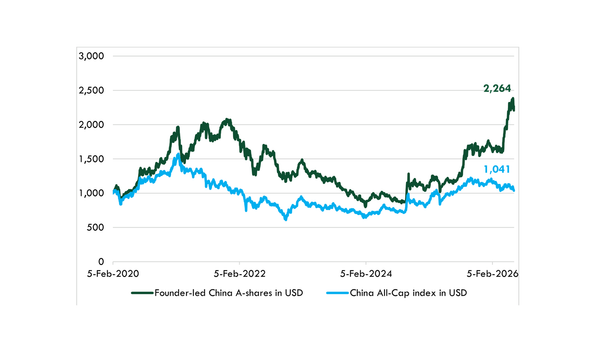
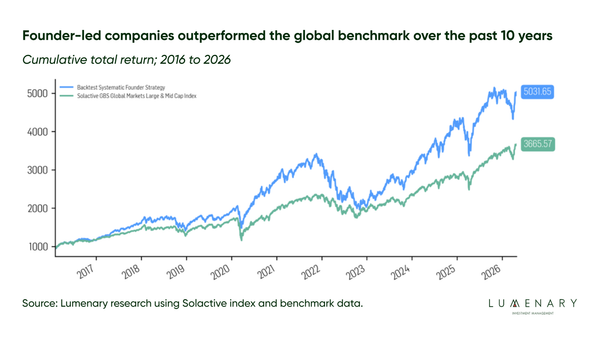
Instead of trying to fit a square peg in a round hole, the solution is to look for managers who already have ownership in their businesses. Think of them as active owners. These are often the founders or founding families. Through every market cycle, even the pandemic, these founder-led companies have demonstrated outperformance.
Pilots without parachutes
I prefer sitting in planes with pilots who don’t have their own parachute. The same goes for investing. Picking the right pilot is like picking the right steward for your capital.
There are some clues to finding great pilots:
- Exclusive share float. Limited seats on the plane. Founders know equity is the most valuable thing in business. They don’t give it up lightly, sometimes holding onto it through generations (as seen with Hermès, for example).
- Lower executive turnover and smaller boards. Captains who have operated the plane for a long time. This cuts the red tape and bureaucracy in decision making. Apple famously has a no-committee policy.
- Balance sheet strength. These pilots are planning for the entire long haul flight, not just the next stopover. They keep the plane prudently fuelled and focused on the future.
- Unafraid to challenge herd mentality and take calculated risks. They take calculated risks to navigate turbulence. They don’t simply follow what others do. Look for bold founders unafraid to take a different view to the status quo – it’s not about their career, it’s about doing what’s right for the company.
- Future proofing, not just bandaging. Founders think long term. They’ll actively invest in R&D and capex even if it hurts profit over the short-term. They won’t just replace parts in the plane, but they’re willing to upgrade the plane altogether.